Vol.05
Living Within a Landscape Painting
Interview with Bjarke Ingels
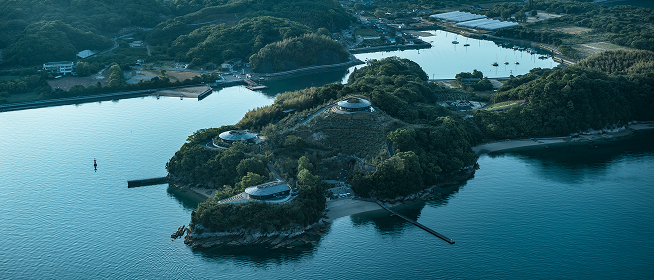
BIG’s first completed project in Japan, NOT A HOTEL SETOUCHI, opened at the end of March. The three villas and restaurant sit on the slopes of Sagishima Island overlooking the Seto Inland Sea. Just as blooming cherry blossoms turned the hillsides white and pink, Bjarke Ingels visited the island to finally see the completed architecture. Once inside the buildings his company designed, what did he feel and how did he spend his time?
“I have to say, and it's not always like this, but I think it's been fantastic, actually.” Looking out over the sea, sky, and scattered islands from the newly completed NOT A HOTEL SETOUCHI, Bjarke speaks with visible excitement.

Bjarke Ingels looking out over the sea from the deep eaves and engawa-like terrace of 180
The SETOUCHI project began with a single email that BIG sent through NOT A HOTEL’s inquiry form in the summer of 2022, and reached completion in fewer than four years. While the studio is known globally for large-scale urban developments and architecture, this is their first completed building in Japan. Bjarke himself has visited Japan around ten times and is very fond of the country. Beyond site visits, he had also traveled through the Setouchi region privately, making the project feel particularly personal. “I think the ideas for the villas, you know, from 360˚ to 1800˚, stemmed from the landscape being so striking, and the view looking like a Japanese landscape painting. It was really the simplest way to almost inhabit the view, by choosing some of the most amazing locations in the topography.”

Slate flooring made from Genkuro-ishi stone is laid throughout each villa’s living and dining space like tatami

360 positioned atop the highest hill on the site. With its glass façade, the villa appears to dissolve into the surrounding landscape
Within each villa’s living and dining space, original curved tables trace the architecture itself, while chairs by legendary Danish designer Poul Kjærholm—pieces Bjarke also uses in his own home—face out toward the scenery. “So we're sitting here in 180, and of course I'm looking out over this beautifully framed view of the Setouchi Archipelago, which is already in itself one of the wonders of the natural world. And then of course here we have this vertically framed view of the sand garden. And because the sand garden is populated by all of the intimate functions—the bath, the toilet, the sauna, the cold plunge—there's all of these moments that almost have the complexity of the archipelago, where each view is framed.”

The table, which curves together with the building, is an original design developed in collaboration with Cassina

At once open to the surrounding landscape, the villa also contains intimate interior spaces enveloped in rammed earth

From the living room of 180, the sea gives way to a Japanese garden framed like a hanging scroll

The primary bedroom of 180. A raised sleeping platform overlooks a small garden with an open-air bath
Three Days in SETOUCHI, Enjoyed Even by His Toughest Critic
Bjarke visited Japan together with his family and stayed at SETOUCHI for three days and two nights. He spent the first night in 270 and the second in 360. “My son Darwin, who's seven—he's a fierce critic. He was incredibly excited by all the houses and was almost having a hard time choosing which home we should stay in.” 180 centers around the atmosphere of a Japanese garden. 270 surrounds guests with water—from the courtyard pool to the surrounding sea. 360 creates a place where people gather around fire. And near the pier sits Beach Terrace 90. As the numerical names increase, the villas gradually climb higher along the hillside, lifting the perspective upward toward the sea.

Three villas scattered across a peninsula extending from Sagishima Island into the Seto Inland Sea

An aerial view of 270, centered around its courtyard pool. The solar panels, designed to resemble traditional kawara roof tiles and used across all villas, are the same system also adopted at Google’s headquarters

The courtyard of 360 features a fireplace designed for gathering around the fire with friends and family
The architecture curves along the contours of the terrain as if the topography itself had risen into built form. Traditional Japanese architectural elements are reinterpreted through contemporary technology: solar panels resembling kawara roof tiles, curved glass façades inspired by shoji screens, Genkuro stone floors laid almost like tatami, and terraces reminiscent of engawa verandas. The walls are formed using rammed earth—layers of earth-based material compacted into formwork. To ensure seismic strength, specially reinforced mixtures were poured by craftsmen bucket by bucket, building only two or three layers each day over the course of nearly six months. ”I do think that the material of the rammed earth provides this geological canvas, and you can see each house is slightly different because the color of the ground was slightly different. It has such a warmth that even though it is a kind of raw wall, it really feels friendly and inviting. I'm incredibly excited about the materialized results.” “Yesterday I was speaking with one of the craftsmen who worked on the rammed earth, and it made me incredibly happy to feel the level of passion they have for architecture. When the people who are actually shaping the building care deeply about what they are making, the architecture simply becomes better. I think Japan still has this culture of craftsmanship and apprenticeship, where there is real respect and pride in working with your hands. And I think that creates one of the best possible environments for making architecture.”

Rammed earth walls that carry the memory of the land itself

The softly darkened curved corridor heightens the sense of release as the space opens toward the landscape beyond
A Japanese Garden Where New Scenes Reveal Themselves Step by Step
Within each villa at SETOUCHI, functions such as studies and shower rooms protrude into the courtyards as pod-like spaces open to the sky through skylights. “Even though it is this kind of concentric courtyard made out of the rammed earth, all those little pockets—like the sky-lit bathrooms, the sauna, the cold plunge—make it so you can never really see the whole courtyard.” In Japanese gardens, there is a technique known as miegakure (“hide and reveal”) in which trees and stones intentionally obscure parts of the landscape so the entire garden cannot be seen from one place. As visitors move through the space, new scenes gradually emerge, creating curiosity and depth. The dimly lit curved corridors at SETOUCHI evoke the same sensibility. “When you look down at the Japanese garden here, you have all those hidden moments. So each house creates a world that is not just the amazing panorama, it's also creating this kind of enigmatic sand garden-like landscape within it.”

Pod-like volumes emerge throughout the courtyard, creating constantly shifting views depending on where one stands. The “islands” nestled between the pods can also be accessed from within the villa.

A study pod open to the sky above. Enclosed horizontally by rammed earth walls, the space creates a strong sense of focus and calm.

Even the ventilation openings visible from the courtyard playfully express each villa’s angle number in Morse code
A Place That Pulls You Back Into the Present Moment
“During the day, we spent a lot of time in 360. I saw the sunset from 270. And then finally with my son, I saw the fireworks. You could still sort of see the silhouette of the mountains and the fireworks lighting up the bay. It was definitely spectacular, because the air is so full of moisture, you have this kind of hazy atmosphere, almost like a watercolor where it looks like the forested hilltops get watered down quite quickly to different shades of blue. So you end up with something that is indistinguishable from a traditional Japanese watercolor, and you realize that the abstraction you see in the painting is much more naturalistic than you expect, because reality actually produces the same level of abstraction from the humidity in the air.”

As the boat approaches Sagishima Island through the scattered islands of the Seto Inland Sea, the surrounding scenery gradually slows one’s sense of time, easing visitors away from everyday life. “The overwhelming scenery and the courtyards somehow disconnect you from the noise and speed of daily life and allow you to focus entirely on simply being present. I think that’s the essential quality of this place—it pulls you back into the present moment.”


STAFF
TEXT
PHOTO
Sanae Sato
Tetsuo Kashiwada, Kenta Hasegawa